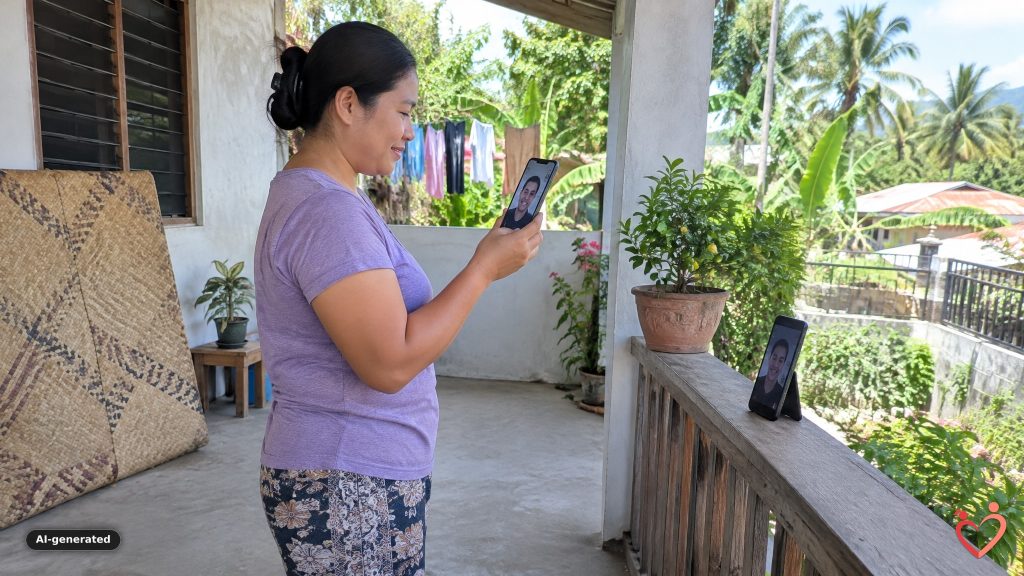
Verify in a set order, and treat every step as evidence rather than proof. Start with checks that need nothing from her, then move to video calls at different times of day, and only then to family calls and ID-related questions.
Key takeaways
- Verify in a fixed order: photo search and profile consistency first, then video calls, then family calls and ID questions only as travel becomes real.
- Run her main photos through both Google Lens and TinEye, because the two tools return different results, and a no-match result proves little either way.
- A second video call at a different time of day tests more than the first, since a single call is easier to prepare for.
- Philippine time never changes for daylight saving, so the gap from US Eastern time is 13 hours in winter and 12 in summer.
- If any check fails, pause travel planning and stop sharing personal details, but treat a failed check as a reason to look harder, not as proof of a scam.
Verifying a Filipina You Met Online, Step by Step
The order matters because the first checks cost her nothing, while the later ones ask for her time and her trust.
Here is a hypothetical situation. You live in US Eastern time and have messaged a woman in Cebu for five weeks. You know her first name, a few profile photos and the city she says she lives in. You are now looking at flights, and you want to know what to do first.
The first three days: checks that need no contact from her
Start with her main profile photos. Run each one through a reverse image search, using both Google Lens and TinEye, because the two tools index different parts of the web and often return different results. A match under another name, or on a stock or modelling site, is a serious warning sign for a fake Filipina profile. For a closer look at what else to watch for, read about the signs of a fake Filipina dating profile.
No match proves little either way. A genuine person may simply have few photos online, and many people keep their pictures off public sites on purpose.
Keep the results to yourself. Do not post her photos in a forum to ask strangers what they think, because that exposes a real person who may have done nothing wrong.
Next, write her age, city, job and family names into a single note. Then read back through the profile and your chat history and see whether they agree. If her profile says 29 and she later mentions a birthday that makes her 34, or the nurse in her profile becomes a call-centre agent in conversation, that is a reason to look harder. It is not a verdict, since people mistype profiles and change jobs.
Timing is part of consistency too. Philippine time is UTC+8 all year and does not change for daylight saving, as the Wikipedia entry on time in the Philippines confirms. From US Eastern time the gap is 13 hours in winter and 12 in summer, because your clocks move and hers do not. If she says she lives in Cebu but her messages arrive at hours that make no sense for that, ask about it. A time-zone mismatch is a question, not proof, and a time converter settles the arithmetic before you start imagining reasons. Night shifts are common in Philippine call-centre work, so an odd hour can have an ordinary explanation.
The rest of the timeline runs roughly like this. Ask for a first video call within the first two weeks. Hold a second one at a different time of day after that. Let a family call happen only if she offers it, and leave location and ID questions until travel is real. Treat this pacing as a few weeks of rough guidance rather than a deadline. No timetable proves anything.
Video, family and ID checks that need her agreement
Once the first checks are done, ask for a first video call, and let her pick the time. Something plain works: “I’d like to see you and hear your voice. Which day and time suit you this week?” Her work shifts, family duties and internet connection are all things you cannot see from your side, so a choice of time shows respect and costs you nothing. If you want more on call setup and safety, here is a safety guide to video calling before you meet.
Then ask for a second call at a different time of day. If the first was her evening, try her morning or a weekend. A single call is easy to prepare for, while two calls at different hours show whether her light, her surroundings and her daily routine match what she has told you about her job and home.
A family call is a later step, and only if she offers it. In many Filipino households, introducing a partner to parents or siblings is a real commitment, not a casual favour, so asking too early can feel like pressure. It helps to know what Filipino parents expect from a foreign boyfriend before that call happens. Seeing relatives on video is more evidence, but it is still only evidence, because a family can be as private as she is.
ID-related checks need the most care. These are reasonable:
- Her name and city stay consistent across your chats, calls and profile.
- She shows a document if she offers, and only once travel is real.
These are intrusive, and a serious partner will rightly refuse them:
- Asking for ID scans to be sent in chat.
- Asking for a home address.
- Asking for her GPS location.
- Searching for her relatives online.
You would not hand a stranger those details, and neither should she.
What These Checks Can and Cannot Prove
You want to know whether she is real. No single check, and no set of them, proves that she is, or that she means what she says. A video call shows a face and a voice. A photo search shows where a picture appears online. A steady story shows that details hold together. Each is evidence and none is proof.
A failed check is not proof of a scam either. A weak connection, a private family or irregular work shifts can look identical from your side of the screen.
There is a trade-off here, and it is worth stating plainly. Heavier checks protect you, but they can feel like a test to a genuine partner. Lighter checks feel warmer, but they leave gaps. If a scammer has approached you before, you may be tempted to skip steps and trust the person who finally feels real. Keep the order anyway. A line of warmth in a message is pleasant, but it is not evidence.
Moving to Facebook Messenger, Viber or WhatsApp is normal, because many Filipinos keep in touch with family and friends that way. Judge the pressure and the timing, not the app.
Some signs are worth pausing for:
- She firmly refuses any live video after several weeks.
- Details shift when you ask a follow-up question.
- She pushes you to hurry travel or change plans at short notice.
Pausing your travel planning is the right response even when you can prove nothing. If you pause and a calm, specific request for a call is met with patience, that tells you something. A serious partner sees you taking the relationship seriously, not insulting her.
These checks do not guarantee a good outcome, and they are not for anyone hoping to skip the slow part. They lower your risk and give you something to weigh. When the checks hold up, the next step is planning the trip once the checks hold up.
Before You Book: A Checklist to Print and Use
Copy these five lines or print them, and tick each one off before you spend anything on a flight:
- This week: run her main photos through Google Lens and TinEye, and keep the results private.
- This week: write her age, city, job and family names in one note, and check that profile and chat agree.
- Within two weeks: hold a first video call at a time she chooses.
- After that: hold a second call at a different time of day.
- Before any booking: confirm her city and district, and discuss ID only if she has offered.
If any line fails, stop sharing personal details and pause your plans. Before you reply, read how to avoid romance scams in the Philippines and the site’s scam-avoidance page.
Frequently asked questions
Is it a red flag if she only wants to video call at certain times?
Not by itself. Work shifts, family duties and internet access all limit when she can talk, and Philippine time differs from yours by 12 or 13 hours if you are on US Eastern time. A firm refusal of any live video after several weeks is a different matter, and a good reason to pause travel planning.
Is it normal for her to move our chat to Messenger, Viber or WhatsApp?
Yes. Many Filipinos use those apps to stay in touch with family and friends. Judge the pressure and the timing of the request rather than the app itself.
Can I ask to see her ID?
Only in a limited way. Keeping her name and city consistent is a fair expectation, and she may choose to show a document once travel is real. Do not ask for ID scans in chat, a home address, her GPS location or searches on her relatives.
What if her photos show up in a reverse image search under another name?
Treat it as a serious warning sign and pause your travel planning. Stop sharing personal details, and read the scam-avoidance guide before you reply to her. Keep the results private rather than posting her photos for strangers to judge.
If she passes every check, can I be sure she is genuine?
No. A video call shows a face and a voice, a photo search shows where a picture appears, and a steady story shows that details hold. Together they give you evidence to weigh, but no set of checks proves she is real or sincere.