Filipino2Meet is a dating platform founded in 2019, and you can test what it says about itself with five checks that work on any Filipina dating site. No article can certify a site as legitimate, this one included.
Key takeaways
- Five site checks (operator, contact, terms, reporting tools and public footprint) each give evidence to weigh, and none proves a dating site genuine on its own.
- A WHOIS lookup shows a domain’s registration date and registrar; a registration date well after 2019 is a question rather than proof, because sites move domains.
- Test a person in four steps: reverse image search every photo, watch for a consistent story, ask early for a live video call, and end contact at any request for money.
- Scammers operate on every dating platform, so no site can guarantee who is on it or how a match turns out.
- Report a suspect profile through the platform first, then to your country’s fraud body, such as the FTC or IC3 in the US or Scamwatch in Australia.
What you get here is a method: five checks on the site, four on the person, and a list of red flags. Each check gives you evidence to weigh, and none proves anything alone. You decide how much evidence is enough.
Filipino2Meet Legitimacy: Five Checks You Can Run Yourself
To keep this concrete, work through one hypothetical profile. It has no name, no photos and no real case behind it. It shows a handful of well-lit photos and says the connection is too poor for a video call. After about a week it suggests moving to a private messaging app, and it keeps finding reasons not to appear live.
You will check the site first, then the person. The order matters, because a site with nothing behind it makes every profile on it harder to trust.
1. Operator. Open the terms and the footer. You want a named company and a postal address, which you can look up in the official company register of the country it names, such as Companies House in the UK. A registered company at that address is reassuring. No named operator is worrying, because it leaves you nothing to check. Also note the spelling: the domain and some page titles use “Filipinos2Meet”, so see which form the terms treat as the official brand name.
2. Contact. Send one real question, such as how to report a profile. A substantive reply from a company domain is a good sign. A canned line, silence, or an answer from a free webmail account is not.
3. Terms and privacy. Look for specific rules on fake profiles and money requests, what happens after a report, and how to delete your account. Wording like “we take safety seriously” with no specifics tells you little. Rules that say what the company will do, and when, tell you more.
4. Reporting and blocking. Find the report and block options on a profile page before you share personal details or leave the site. If you can only see them after signing up, note that, then check again once you are inside and before you share anything personal. It also helps to compare what the platform’s own safety tips say with what you actually see on the page.
5. Footprint. Run a WHOIS lookup on the domain. It shows the registration date and the registrar, and many registrars hide the owner’s personal details, so those two fields are often the only ones you can read. Compare the date with 2019. A domain registered years later is a question, not proof, because sites move domains. Then search the brand name with “complaint” or “scam”. Read reviews for specifics and for whether the company replies, not for star ratings. This guide stays on the method, so for feature detail see our honest look at safety and features.
A site can pass all five checks and still host someone who is not who they say they are.
That is why the hypothetical profile needs its own tests.
Verifying a Person You Meet on Filipino2Meet
Two of the checks need no account and no special skills. You have just used one, WHOIS, on the site. The other is a reverse image search on each profile photo, using Google Lens or TinEye, which can show where else a photo appears online.
Run these four on the hypothetical profile, in this order:
- Reverse image search. Search every photo, not just the first. Photos that turn up under other names, or on stock and modelling pages, are a serious warning. A clean result is not proof, though, because a new photo may simply not be indexed yet.
- A consistent story. Keep short notes on job, town, family and dates. Over weeks of messages, the details should stay the same. Details that shift, or answers that dodge a simple follow-up, are a signal.
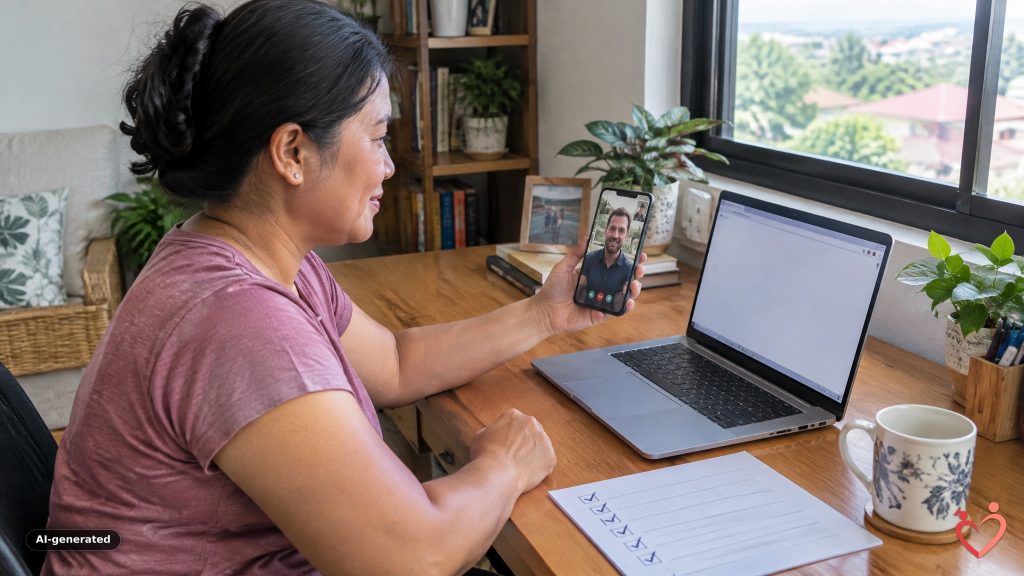
- A live video call. Ask for one early, and ask again if it falls through. A weak connection can be real, so offer a different time, a different app, or a five-minute call. If you want a step-by-step, here is how to set up a safe video call before you meet. A profile that finds a new reason after several attempts has told you something.
- No requests for money. Any request, however small, urgent or well explained, ends the contact.
Now the red flags. They apply on any platform:
- Affection that moves unusually fast
- A reason you cannot meet or video call
- A sudden emergency
- Requests for money, bank details or identity documents
- Pressure to leave the site
Every one of these describes behaviour. None depends on where someone lives, what their culture is, or how any woman is supposed to act. A person from anywhere can send the same messages, which is why you judge the pattern and not the passport.
Any one flag is a reason to slow down. A request for money is a reason to stop.
Our hypothetical profile has already shown two: a reason it cannot go on camera, and a push towards a private app. The sensible response is to slow down, propose a call at a time that suits them, and stop replying if the answer is another reason. If you have been approached before, how to avoid scams on Filipina dating sites covers the common patterns in more depth. And signs of a fake Filipina dating profile adds profile-level details to look for.
About Filipino2Meet and What No Dating Site Can Promise
Filipino2Meet is an online dating platform founded in 2019. It connects Filipina and Filipino singles with each other and with foreign singles who are looking for relationships with people from the Philippines. Filipino members use it free. This guide sits on Filipino2Meet’s own blog, so read it with that in mind and run the checks yourself.
The platform cannot guarantee a match, a relationship, a marriage or a safe meeting. It cannot confirm every person’s identity either. Scammers appear on every dating platform, because the scam runs on trust and urgency, not on one site’s weakness.
The checks have a cost, and you should know it before you start. They take time, and early on they can feel cold, especially when you are enjoying a conversation. Your match may also have honest reasons to decline a video call, such as privacy, a shared device or plain nerves. A refusal is a question, not a verdict. If you meet a refusal with patience and a second suggestion, a genuine person will usually give you something to work with.
Is Filipino2Meet a Scam? Short Answers on Safety and Reporting
Filipino2Meet and scams: Scammers can appear on any dating platform, Filipino2Meet included, so nobody can honestly promise a site is scam-free. If a profile looks wrong, stop replying first, then report it. Safety here comes from your habits as much as from the site’s rules.
Polished profiles and convincing photos: They prove nothing. A reverse image search and a live video call are tests, and neither confirms identity alone. Use both, and add the consistency check over time.
Where to report: Use the report option on the profile first. Then contact your country’s official body: the FTC or the FBI’s Internet Crime Complaint Center (IC3) in the US, the Canadian Anti-Fraud Centre, Scamwatch in Australia, the National Bureau of Investigation or the PNP Anti-Cybercrime Group in the Philippines, and the national police fraud channel in the UK, Germany and New Zealand. Check the current address on each official site.
When you are ready, create a free profile, then apply this checklist to the site and to your first match.
Frequently asked questions
How soon should I ask for a video call?
Ask within the first week or two of messaging, before the conversation becomes emotionally heavy. Early requests are easier to make and easier to accept. If the first attempt falls through, suggest another time or app and ask again.
What if a genuine person simply won’t video call?
Some people have private reasons, so ask once more and offer alternatives such as a shorter call or a different time. Repeated refusals with new excuses are a reason to slow down. Do not make plans to travel or share sensitive details until you have seen the person live.
Can I trust Filipino2Meet reviews and review sites?
Read them for specifics, such as what happened and whether the company replied, and ignore star ratings. Many review pages are affiliate-driven, and this guide sits on Filipino2Meet’s own blog. That is why it gives you a method to check for yourself.
What should I do if I’ve already sent money to someone?
Stop contact, keep every message, and tell your bank or payment provider straight away. Then report the profile on the platform and to your country’s fraud body. Don’t send more money to recover what you lost, since that is a common follow-up trick.